

Fluence in Laser Hair Removal: A Beginner’s Guide
When discussing laser hair removal, terms such as wavelength, pulse duration, spot size and cooling often come up. But understanding fluence in laser hair removal is just as important, as it describes how much laser energy is delivered over a specific area of skin.
Fluence plays a major role in determining whether enough energy reaches the hair follicle to produce the desired thermal effect, while treatment parameters must also be selected carefully to protect the surrounding skin.
For clinics working with professional laser systems such as the Candela Gentle Pro™ Series, understanding fluence is therefore an important part of understanding how effective laser hair removal works.
What Is Fluence?
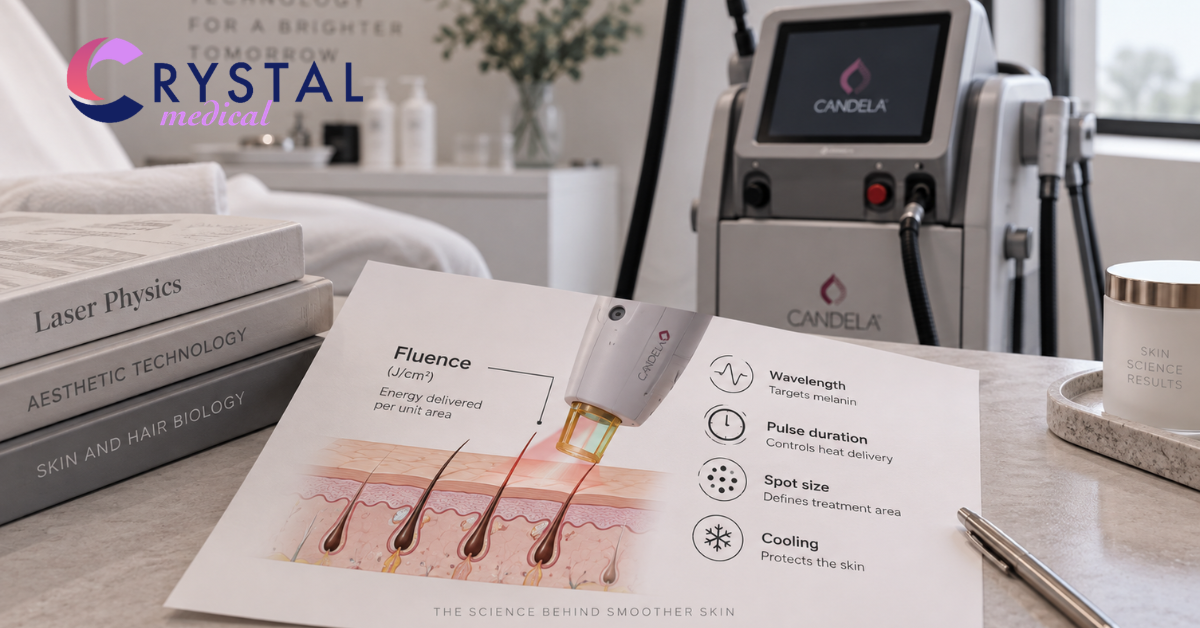
Fluence is the amount of laser energy delivered per unit area and is usually expressed in joules per square centimetre (J/cm²).
In simple terms:
Fluence = Energy ÷ Area
For example, if a laser delivers a certain amount of energy across a defined treatment spot, fluence tells us how concentrated that energy is within that area.
Candela similarly defines fluence as laser pulse energy relative to the spot size being used. Fluence influences how much energy is available to affect the intended target — in laser hair removal, primarily melanin within the hair follicle.
Why Does Fluence Matter in Laser Hair Removal?
Laser hair removal is based on the principle of selective photothermolysis.
The laser emits light at a wavelength that is absorbed by melanin in the hair. That absorbed optical energy is converted into heat, allowing thermal damage to be concentrated in structures associated with the hair follicle while limiting unnecessary damage to surrounding tissue.
Fluence is one part of this process because the amount of energy delivered influences the thermal effect produced within the target.
If insufficient energy reaches the follicle, the treatment may not create the intended thermal effect. Increasing fluence can increase treatment efficacy, but higher fluences can also increase the possibility of adverse effects. This is why professional laser treatment is not simply about using the highest possible setting.
Higher Fluence Doesn’t Automatically Mean Better Results
One of the most important things for beginners to understand is:
More energy does not automatically equal a better treatment.
The objective is not to maximize fluence. It is to use appropriate treatment parameters for the individual patient, treatment area, hair characteristics and device.
Laser treatment involves balancing several variables, including:
- fluence
- wavelength
- pulse duration
- spot size
- skin type
- hair thickness and pigmentation
- treatment area
- epidermal cooling
These parameters interact with one another, which means fluence should never be considered in isolation. Current reviews of laser treatment emphasize selecting wavelength, fluence, pulse duration and spot size together according to factors such as skin type, treatment endpoint and cooling.
Fluence and Skin Type
Skin contains melanin too.
This creates one of the fundamental challenges of laser hair removal: the laser needs to effectively target melanin associated with the hair while minimizing unwanted heating of epidermal melanin.
The appropriate wavelength and treatment parameters therefore depend partly on the patient’s skin type.
Long-pulsed 755 nm Alexandrite lasers are widely used for hair removal, particularly in lighter skin phototypes, while 1064 nm Nd:YAG technology is commonly used for darker phototypes because of its different interaction with melanin and greater penetration depth.
This is one reason platforms that provide multiple wavelengths can give practitioners greater flexibility.
Fluence in Candela Laser Systems
Candela Medical systems provide a useful example of how fluence forms part of a larger treatment equation.
The GentleMax Pro®, for example, combines a 755 nm Alexandrite laser with a 1064 nm Nd:YAG laser. Its available fluence ranges vary depending on wavelength and spot size.
The newer GentleMax Pro Plus® also combines 755 nm Alexandrite and 1064 nm Nd:YAG wavelengths and offers additional flexibility in areas such as spot size, pulse duration and energy delivery. Candela reports that the platform can use short pulse durations for fine hair and higher fluence capabilities in selected configurations.
This demonstrates an important principle: a fluence value cannot be properly interpreted without knowing the other treatment parameters.
For example, 12 J/cm² used with one wavelength, spot size and pulse duration does not necessarily produce the same clinical effect as 12 J/cm² delivered under a different combination of parameters.
What Does Spot Size Have to Do With Fluence?
Spot size describes the diameter of the laser beam delivered to the skin.
It is closely connected with fluence and overall laser performance. Different spot sizes can have different available fluence ranges, and larger spot sizes can also affect how laser energy penetrates tissue.
This is why changing spot size isn’t simply a matter of covering a larger area faster. The practitioner needs to consider the complete set of treatment parameters.
For example, Candela’s published GentleMax Pro specifications show different available fluence ranges depending on the selected spot size for both Alexandrite and Nd:YAG wavelengths.
Fluence and Pulse Duration Work Together
Another important parameter is pulse duration, usually measured in milliseconds for long-pulsed hair removal lasers.
Pulse duration describes how long the laser energy is delivered during each pulse.
Generally, hair characteristics influence how these parameters are selected. Candela notes that larger, denser or thicker targets may require longer pulse durations, while smaller or finer targets may benefit from shorter pulse durations.
The GentleMax Pro Plus, for example, offers short pulse capabilities intended to expand treatment options for fine hair. Candela has published clinical data evaluating short pulse durations with both its Alexandrite and Nd:YAG wavelengths.
Again, this illustrates why asking only “What fluence should I use?” leaves out important information.
What About Cooling?
Delivering effective laser energy also requires protecting the epidermis.
Candela’s Gentle systems can use the Dynamic Cooling Device™ (DCD™), which delivers a controlled burst of cryogen to the treatment area immediately before the laser pulse. The purpose is to cool and protect the epidermis while laser energy targets structures below the skin surface.
Cooling becomes particularly relevant when considering factors such as fluence and skin pigmentation. It is therefore another component of the overall treatment strategy rather than an independent comfort feature.
A Simple Way to Think About It
Imagine trying to cook something using heat.
Fluence is similar to how much energy you deliver.
Pulse duration determines how quickly or slowly that energy is delivered.
Spot size affects the area being treated.
Wavelength determines which structures absorb the energy most effectively.
Cooling helps protect the surface.
Changing just one of these variables changes the overall interaction.
Laser hair removal works in much the same way: successful treatment depends on the relationship between multiple parameters rather than one “perfect” fluence number.
Why Professional Training Matters
Modern laser platforms give practitioners considerable control over treatment parameters. That flexibility is valuable, but it also makes proper training and understanding of laser-tissue interaction essential.
Treatment parameters should be selected according to the manufacturer’s instructions, applicable clinical protocols and the individual patient’s characteristics. Practitioners should not simply copy a fluence value used for another patient or increase energy solely because previous results were limited.
Skin type, tanning status, hair characteristics, treatment area, wavelength, spot size, pulse duration and cooling all need to be considered together.
Fluence Is Only One Part of Effective Laser Hair Removal
Fluence is one of the fundamental concepts behind laser hair removal, but it should never be viewed as a standalone number.
It tells us how much laser energy is delivered per unit area, while the actual treatment effect depends on how that energy interacts with the wavelength, pulse duration, spot size, cooling system and characteristics of the patient’s skin and hair.
Understanding these relationships helps practitioners move beyond simply adjusting settings and toward understanding why different laser parameters produce different clinical effects.
At Crystal Medical, we supply professional Candela laser systems and support clinics across Cyprus with advanced technology for aesthetic practices.
If you’re considering adding a Candela laser system to your clinic or upgrading your existing equipment, contact Crystal Medical to learn more about the available solutions.